
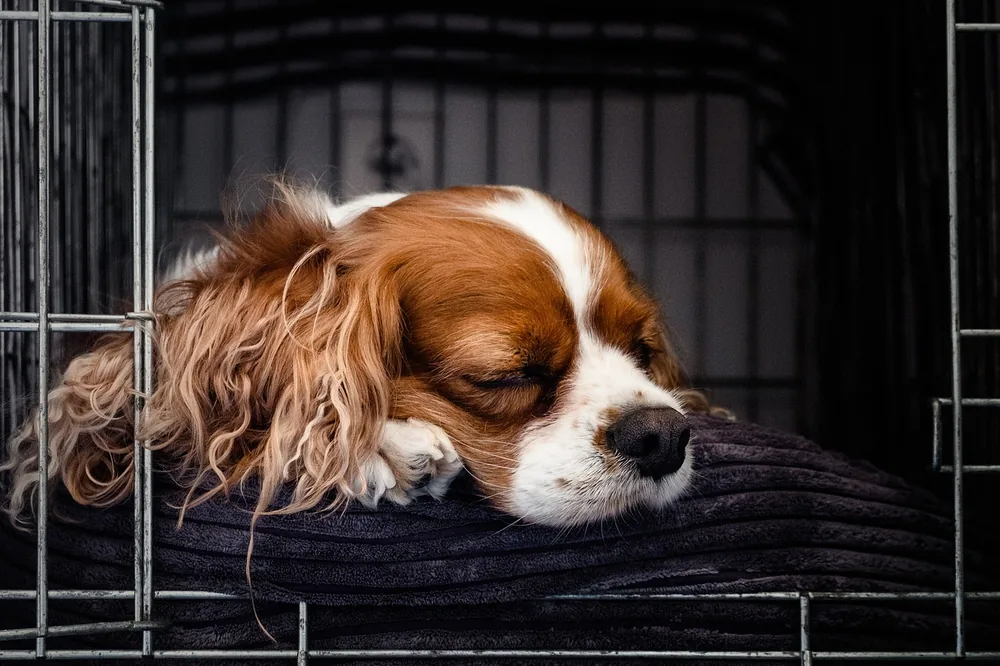
Most puppies don’t fail crate training. The schedule does. Owners try to rush the door-shut step, skip the food-association days, or leave the puppy alone too long on Day 2 — and then spend three weeks undoing the panic the crate now triggers. Done correctly, the first seven days lay a pattern that holds for the next decade.
This is the seven-day plan we use with every puppy that walks into our orbit, including Kai when we brought him home as an 8-week-old GSD/Rottie rescue. Slow on Days 1–2, food-loaded on Days 3–4, door-closed in increments on Days 5–6, full overnight on Day 7. No shortcuts.
Quick answer: A 7-day crate training plan moves the puppy from open-door exploration (Days 1–2) to feeding meals inside (Days 3–4) to short closed-door reps with the owner present (Day 5) to longer absences (Day 6) and full overnight by Day 7. The whole protocol depends on never letting the puppy panic — back up a step the moment they do.
Why crate training works at all
Dogs are denning animals. Wild canids dig themselves into small, enclosed spaces to sleep — not because they’re trapped, but because tight quarters feel safe. A correctly-sized crate isn’t a cage; it’s a structure your puppy already wanted. The Animal Humane Society and the AKC both frame crate training as taking advantage of an existing instinct, not imposing a new one.
That framing matters because it tells you how to handle setbacks. If the puppy refuses the crate, the crate has been associated with something bad — usually isolation, a closed door before they were ready, or bedding the owner pulled out as punishment. Don’t push through; back up to the previous day’s step and rebuild the association.
What you need before Day 1
Three things before the puppy goes near the crate:
- The right crate size. Your puppy should be able to stand to full height, turn in a circle, and lie down stretched out — and nothing more. Too big and they’ll potty in one corner and sleep in another, which destroys the housetraining benefit. A divider panel solves this: shrink the usable space now, expand as they grow.
- A stuffable toy for crate-positive associations. The food-loaded toy is what makes the crate the most rewarding spot in the house, not the most boring one.
- Soft, low-calorie training treats for luring and rewarding the early entry reps. Pea-sized and swallow-in-two-seconds — anything that takes chewing breaks the rep.
The crate we use
For most medium-to-large breeds, the 42-inch single-door MidWest iCrate is the standard the rescue trainers we know default to. Single-door folding wire, divider panel included, leak-proof tray. It folds flat for vet visits and survives a chewer. It’s the same style of crate Kai grew up in.
The toy that does the heavy lifting
The KONG Classic is what makes the crate actively good, not just tolerable. Stuff it with peanut butter or KONG’s filling paste, freeze it overnight, and hand it over when the puppy goes into the crate. The puppy associates the crate with a 20-minute high-value job, not with being locked away.
The 7-day protocol
Each day builds on the previous. Don’t compress the schedule even if the puppy seems ready — the early days look easy because you’re not asking for much yet.
Day 1: Crate exists, door is open
Set the crate up where the family already spends time — the kitchen, the living room, wherever the puppy will see you most. Take the door off entirely or prop it open so it can’t accidentally swing shut. Drop a few treats just inside the front lip, then a few near the middle, then a few at the back. Walk away. Let the puppy investigate without you watching.
Goal for Day 1: the puppy walks all the way in to grab a treat at the back, then walks out, on their own, at least three separate times. No door closing. No commands. No pressure.
Day 2: Meals near the crate, frozen KONG inside
Feed every meal directly in front of the open crate door — bowl outside, but right against the front edge. After the meal, drop a frozen stuffed KONG just inside the crate. The puppy goes in for the KONG voluntarily and chews it out (still with the door open).
You’re stacking three positive associations: food appears near the crate, the highest-value chew of the day appears inside the crate, and nothing scary has happened yet. By the end of Day 2 the crate should be a place the puppy chooses to walk into.
Day 3: Bowl moves inside
Put the food bowl all the way inside the crate, against the back wall. The puppy now walks fully in to eat. Stand or sit nearby — your presence is a reassurance, not a hovering correction. Door still open.
If the puppy hesitates and eats only the front of the bowl: you moved the bowl too far back, too fast. Pull it forward an inch. Try again at the next meal. Patience here is the whole game.
Day 4: Door closes for 30 seconds
This is the make-or-break day. The puppy is eating in the crate. While they’re mid-meal, gently close the door for 30 seconds. Open it the moment they finish — not before, not as a reaction to whining.
Repeat at the next meal, this time for 60 seconds after they finish. Then 2 minutes. Then 5. Always with you in the room. If the puppy whines or panics, you went too long — back up to a duration where they’re calm, do three more reps at that duration, then advance more slowly. Day 4 pairs with the Free Puppy Plan’s Day 4 module; both target the same threshold-crossing rep.
Day 5: You leave the room
Door closed, frozen KONG inside, you walk out of sight for 1 minute. Come back calmly — no big greeting. The puppy needs to learn that your leaving and returning is unremarkable, not a separation anxiety trigger.
Build duration in increments: 1 minute, 3 minutes, 5, 10, 20. Always with the KONG occupying the puppy. Always returning before the chew is finished — you want the puppy associating “owner returns” with “still a good time,” not with rescue from boredom.
Day 6: Daytime crate during real life
Use the crate for real reasons — when you’re cooking dinner, when the doorbell rings, when you need 30 minutes uninterrupted. Frozen KONG goes in with the puppy. Duration: up to (puppy’s age in months) + 1 hours, maximum. A 2-month-old can hold three hours; a 4-month-old, five. Past those limits, bladder physiology takes over and the crate becomes a potty spot.
Day 7: First full night
Crate goes in your bedroom for the first overnight — not the laundry room, not down the hall. The puppy is still a litter-mate-deprived 8-week-old and isolation at night triggers panic in nearly every breed. Hearing you breathe is what lets them sleep.
Take the puppy out for a final potty break right before bed. Put them in the crate with a low-grade chew (a cooled, partially-finished KONG works). Expect one wake-up around 3 a.m. for a quick potty trip back to the same spot in the yard, then straight back to the crate. By Night 3 of overnight crating, most puppies sleep through.
The night-specific protocol — including how to handle 4 a.m. whining without rewarding it — is covered in our night-time crate training guide.
What to do when the schedule slips
Two failure modes are by far the most common.
The puppy panics on Day 4. You closed the door too fast, or the puppy wasn’t fully comfortable eating inside on Day 3. Symptoms: barking, scrambling, drooling, refusing food. Open the door immediately, take the food out, and run Day 3 again for two more days before re-attempting Day 4. The crate is not yet safe in their head — pushing through cements the panic.
The other classic mistake: letting the puppy out while they’re whining. The puppy learns whining produces freedom. Wait for a 5-second pause in the noise — even mid-sentence — then open the door. They’re learning that quiet is the cue, not noise.
The puppy refuses the crate from Day 1. Often the crate is too big, the room is too noisy, or there’s a previous bad association from a shelter or transport. Try a smaller divided space first, lower the noise, and add a worn t-shirt of yours to the floor. The familiar scent does more than people credit it for.
How long can a puppy stay crated?
The age-in-months-plus-one rule is the standard the AKC and Animal Humane Society both reference: an 8-week-old (2 months) tops out at 3 hours; a 4-month-old at 5 hours; a 6-month-old at 7 hours. Past those windows, bladder control fails and the crate becomes a place the puppy soils — which permanently breaks the housetraining association we built in week one.
Working owners with 8-hour days need a midday break, a dog walker, or a crate-and-pen setup that gives the puppy access to a potty pad outside the crate. The schedule isn’t optional just because work is.
Frequently asked questions
Can a puppy really be crate trained in 7 days?
The protocol takes 7 days; full reliability takes longer. By Day 7 most puppies will sleep overnight in the crate and tolerate 3-hour daytime stints. Silent self-settling, multi-hour comfort without a stuffed toy, and travel-crate use generally develop over the next 4–6 weeks of consistent practice.
What if my puppy whines all night the first time?
Expect 20–40 minutes of whining on Night 1 even with a perfect Days 1–6. Don’t intervene unless you suspect a real potty need (typically a single 3 a.m. break). Take them out silently, no play, no praise — straight back to the crate. Whining stops faster when it doesn’t produce attention.
Should the crate go in the bedroom or somewhere else?
Bedroom for the first 2–3 weeks. Puppies isolated at night develop nighttime separation distress that takes weeks to undo. After three weeks of solid overnight crating, you can move the crate to a permanent location if you prefer.
Is it cruel to crate a puppy?
No — provided the crate is correctly sized, the puppy isn’t crated past the age-plus-one limit, and the crate has positive associations built through the protocol above. Crating a puppy 10 hours a day with no exercise or enrichment is cruel; using a crate as a structured rest spot inside a balanced day is what every responsible breeder, rescue, and AKC-affiliated trainer recommends.
What size crate do I actually need?
Measure the puppy’s projected adult size, not their current size, and buy that crate with a divider. Stand-up height + nose-to-tail length + 4 inches in each direction. For most retrievers, GSDs, and rotties, 42 inches is right; for smaller breeds (cockers, beagles, terriers), 36 inches; for toy breeds, 24–30 inches.
Should I cover the crate with a blanket?
Often yes — most puppies settle faster in a darker, more den-like space. Use a breathable cover (a thin cotton blanket or a purpose-built crate cover), drape three sides only, and watch for chewing at the edges. If the puppy pulls the cover into the crate, remove it for safety and try again in a week.
What do I put inside the crate?
A flat washable bed if the puppy is past the chewing phase; a worn t-shirt and a frozen KONG if not. Skip blankets and plush toys with stuffing during the first month — the chew risk isn’t worth the comfort.
Bottom line
Seven days is enough to build the crate-as-den association if every day’s step lands cleanly. Rush Day 4 and you’ll spend a month rebuilding trust. Get the crate size right, run the food-loaded KONG protocol, and never let the puppy out while whining — those three rules carry most of the result. For the broader 30-day picture this fits inside, see the Free Puppy Plan; for the gear that makes Days 1–7 easier, our 5 puppy training essentials covers the full first-month kit.
Related reading
- How to crate train a puppy at night — the overnight-specific protocol.
- All dog training guides — the rest of the training pillar.
- 5 puppy training essentials for Day One — the gear we use across the first six months.