
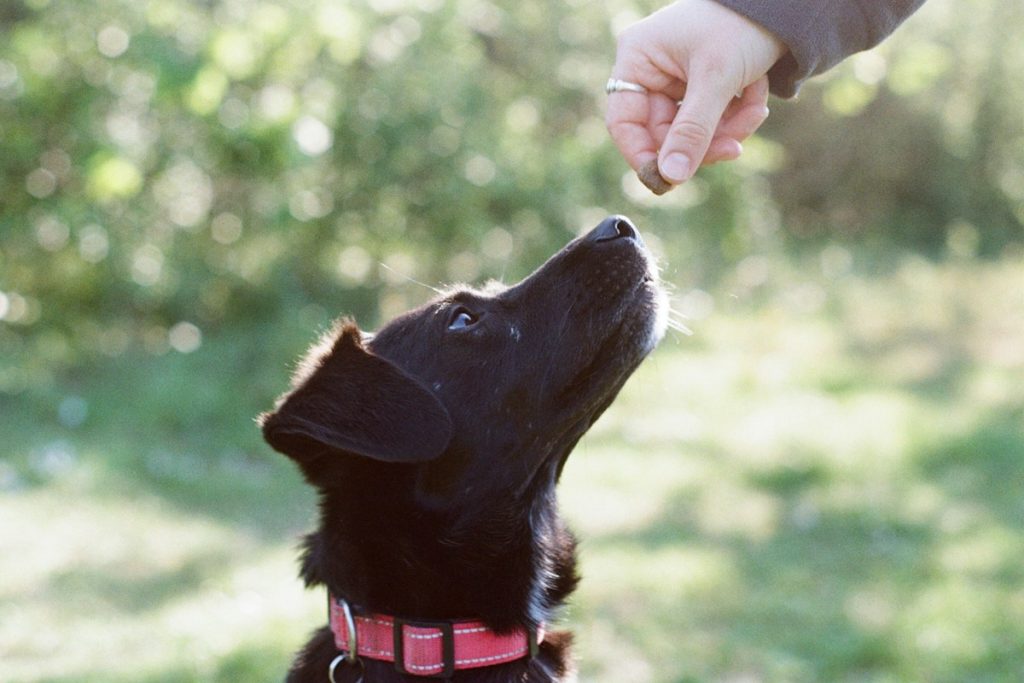
If you’ve ever tried to teach a tiny puppy to sit and watched them lose interest before the third rep, the treat is usually the problem. Too crunchy, too big, too dry, too many calories — any one of those will tank a training session before it starts. The best training treats for puppies solve all four problems at once: small enough to swallow in a heartbeat, soft enough to chew without crumbs, low enough in calories to repeat 30 times, and stinky enough that your puppy will actually work for them. These five tiers are the ones we keep coming back to with our own dog, Kai, and they’re the ones we’d hand any new puppy owner.
Quick answer: The best training treats for puppies are small, soft, low-calorie, and high in real meat — under 3 calories each is ideal. Our top pick is Zuke’s Mini Naturals: chicken-flavored, about 2 calories per treat (per Zuke’s), soft enough for sensitive puppy teeth, and tiny enough to feed 30 in a session without blowing past the 10% treat-calorie rule.
How we picked
Picking puppy training treats isn’t complicated, but the four criteria below are non-negotiable. Skip any one of them and your training session falls apart.
- Size. Pea-sized at most for medium and large breeds. Smaller for toy breeds. The American Kennel Club specifically recommends tiny treats for training so the puppy can finish quickly and keep going. Anything bigger than your pinky-nail slows the session down.
- Calorie count. Veterinarians recommend treats stay below 10% of a puppy’s total daily calories. With young puppies eating 30–100 treats per training day, that means 2–4 calories per treat is the sweet spot.
- Texture. Soft and chewy beats crunchy every time. Crunchy treats crumble, scatter on the floor, and burn 10 seconds of training time while your puppy hunts for crumbs. Soft treats vanish in one chew.
- Ingredients. Real meat first. No artificial colors, preservatives, or vague “meat by-products.” Puppies have sensitive digestive systems, and a fillers-first ingredient list is the fastest way to a queasy puppy on training day.
We also weight price-per-treat. Training treats are a per-session expense, not a once-a-month splurge. A bag that lasts two weeks needs to cost like one.
Comparison at a glance
| Tier | Pick | Calories per treat | Texture | Best for |
|---|---|---|---|---|
| Best overall | Zuke’s Mini Naturals | Under 3 | Soft, moist | Daily training sessions, all breeds |
| Best ultra-low calorie | Single-ingredient freeze-dried liver | <1 | Crumbly but tiny | Long sessions, weight-watching puppies |
| Best soft and meaty | Pet Botanics Training Rewards Minis | 1.5 | Soft, pliable | High-value rewards, distracting environments |
| Best budget | Wellness Soft Puppy Bites | 6 | Soft, chewy | New owners on a budget, daily use |
| Best for picky eaters | Buddy Biscuits Trainers | 1.5 | Very soft | Puppies who turn their nose up at everything else |
The picks
Best overall: Zuke’s Mini Naturals
Zuke’s Mini Naturals is the treat our team reaches for first when a new puppy starts training, and it’s the one we keep stocked at home for Kai’s daily refresher sessions. Three reasons it earns the top spot.
First, the size. Each treat is roughly the size of a pencil eraser — small enough that even a 10-week-old toy breed can swallow it in one motion. No tearing in half, no waiting for chewing. The session keeps moving.
Second, the calorie math. At about 2 calories per treat, you can deliver a 30-treat training session for under 100 calories. That keeps the treats inside the vet-recommended 10% of daily intake even for a six-pound puppy.
Third, ingredients. The first ingredient is real chicken (or salmon or rabbit, depending on the variant), not corn or wheat or “meat meal.” No artificial colors or preservatives. The texture is soft and slightly moist, which makes them more aromatic — and aroma is what wins a puppy’s attention when you’re competing with a squirrel.
Why this is our pick: small enough, low-calorie enough, soft enough, and real-meat-first. The 16-ounce bag goes a long way, and most new owners can stretch it through three to four weeks of daily training. We use these with the Day 1 sit work in our free puppy plan.

Best ultra-low calorie: Single-ingredient freeze-dried liver
If you’re running long training sessions — say, working on recall for 20 minutes in a distracting environment — calories add up fast. Single-ingredient freeze-dried liver treats (beef liver, chicken liver, or salmon are most common) clock in at under 1 calorie per piece. Most brands sell them as small cubes that crumble easily into half-pinky-nail bits.
The trade-off: they crumble. If you’re working outdoors on grass or carpet, the crumbs disappear into the texture and your puppy can spend several seconds hunting for them. That’s why we use freeze-dried liver as a high-value reward layered on top of soft treats — break out the liver for the hard reps (recalls from distractions, calm greetings) and use softer treats for the everyday work.
Look for products that list only one ingredient on the label: “beef liver” or “salmon.” If you see “natural flavor,” “tocopherols,” or grain fillers, keep moving. The whole point of freeze-dried is that it’s a single clean protein.
Best soft and meaty: Pet Botanics Training Rewards Minis
Pet Botanics Training Rewards Minis are what we reach for when a puppy keeps “checking out” mid-session. The texture is more pliable than Zuke’s — almost jerky-like — which makes them feel more like real food to a picky puppy. Pork liver is the first ingredient, and the Minis are just 1.5 calories per treat, so you can pay generously.
The bag is bigger than most competitors at the same price point, so the cost-per-treat works out favorably even though the per-pound price looks higher. They hold up well in a treat pouch in your pocket for several hours without going gummy.
One small note: buy the Minis, not the standard Training Rewards, which are noticeably larger and higher in calories.
Best budget: Wellness Soft Puppy Bites
For new owners staring at the cost of crate, leash, harness, food, vet visits, and training treats all in the same week, Wellness Soft Puppy Bites are the treat we recommend to keep the budget in check without compromising on the four criteria above. Real lamb and salmon, soft texture, and DHA added for brain development — a nice bonus on a puppy treat specifically. The trade-off: at about 6 calories per treat, they’re the highest-calorie pick here, so tear them in half for small puppies and count them toward the daily total. They’re also grain-free (see the FAQ below on why that isn’t a reason to choose them on its own).
Wellness as a brand has a track record on transparency and sourcing that we trust.
If you’re on the fence between this and Zuke’s, the honest answer is: Zuke’s is slightly better on aroma and slightly higher quality on ingredients, but Wellness gets you 85% of the way there at a noticeably lower price. For first-month puppy budgets, that math wins.
Best for picky eaters: Buddy Biscuits Trainers
Every now and then a puppy looks at Zuke’s, Wellness, and Pet Botanics with the same indifference they’d give a piece of cardboard. For those puppies, Buddy Biscuits Trainers are what we reach for next. The soft texture is the softest of any treat on this list — almost playdough-like — and the smell is strong. They’re made for training, at about 1.5 calories per piece.
The ingredient list is slightly longer than Zuke’s, and they’re grain-based rather than meat-first. But when nothing else is working, they’re often the treat that finally gets a focused puppy. That’s worth a lot in early training when motivation is the whole game.
What to look for when buying
Most of the marketing on puppy training treat bags is noise. These are the things actually worth checking before you put one in the cart.
Real meat as the first ingredient
Flip the bag over. The first ingredient should be a named meat — “chicken,” “salmon,” “lamb” — not “meat meal,” not “by-products,” not corn or wheat or oats. Puppies are growing fast and need quality protein. The treat doesn’t have to be a balanced meal, but it shouldn’t be empty filler either.
Calorie count printed on the bag
Reputable training treat brands print calories-per-treat right on the bag. If you can’t find that number, the brand probably doesn’t want you doing the math. Aim for under 4 calories per treat. Under 3 is even better if you train multiple times a day.
Size you can use without prep
You shouldn’t need to cut, pinch, or break treats to make them session-ready. If the treat as packaged is too big for your puppy’s mouth, look for a smaller alternative. Pre-prep time before a session is a friction point that makes you train less often.
No artificial colors or preservatives
Look for treats preserved with mixed tocopherols (a form of vitamin E) rather than BHA, BHT, or ethoxyquin. Avoid bright red or green dyes. These cosmetic additives exist to make the bag look appealing to humans — your puppy doesn’t care, and their digestive system doesn’t need the extra ingredients.
Resealable bag
Soft treats dry out within days once the bag is open. A zip-top or resealable bag isn’t a nice-to-have, it’s the difference between a bag that lasts three weeks and one that lasts five days.
How to use training treats well
The right treat is half the equation. How you deliver it matters just as much.
- Pre-portion before the session. Count out 20–30 treats into a treat pouch or your pocket before you start. That keeps you from fumbling with the bag mid-rep, and it forces you to be deliberate about quantity.
- Reward fast. A treat that arrives more than 1–2 seconds after the behavior loses its teaching power. Practice marking the behavior with a word (“yes!”) or a clicker so the treat-delivery delay doesn’t break the association.
- Vary the value. Use everyday treats (Wellness, Zuke’s) for known behaviors and high-value treats (freeze-dried liver, a small piece of real chicken) for hard reps in distracting environments. Same dog, different treat — different motivation.
- Track the calories. Subtract the treat calories from the day’s food bowl. A puppy who got 30 training treats at breakfast doesn’t need the full kibble portion at dinner. Vets routinely flag overweight puppies whose owners are doing everything right except this last step.
- Phase out as behaviors solidify. Treats are how you teach the behavior. Real-life rewards — praise, play, freedom to sniff — are how you maintain it once it’s learned. Plan to fade the food rewards on each cue over the first few months.
If you’re still working through the first few weeks of training cues, our guide on how to teach a dog to sit covers the timing and marker mechanics that make these treats actually work. And once sit is solid, the same delivery pattern carries over directly to recall training.
Frequently asked questions
How many training treats per day is too many for a puppy?
The veterinary rule of thumb is that treats should not exceed 10% of a puppy’s total daily calories. For a small puppy eating roughly 500 calories per day, that’s 50 calories from treats — about 17 to 25 Zuke’s Mini Naturals or around 50 freeze-dried liver bits. If you exceed this, subtract the overflow from the food bowl.
Can I use kibble as training treats instead?
Yes, for low-stakes sessions in a quiet environment. For higher-stakes reps — first time outdoors, around guests, with another dog nearby — kibble usually isn’t motivating enough. Keep kibble for living-room sit-stay practice; pull out the high-value treats for real-world training.
What’s the best treat for an 8-week-old puppy?
An 8-week-old puppy needs the softest, smallest treats on this list. Zuke’s Mini Naturals and Buddy Biscuits Trainers are both safe and appropriately sized. Avoid hard biscuits, large freeze-dried cubes, or anything chewy enough to require sustained chewing — at 8 weeks the puppy’s teeth and digestive system are still delicate.
Are grain-free training treats better for puppies?
Not necessarily. The grain-free trend was largely marketing, and the FDA flagged concerns about grain-free diets and heart conditions in dogs starting in 2018. Unless your vet has specifically recommended grain-free for an allergy reason, a treat with wholesome grains (oats, rice) is fine. Focus on real-meat-first and low-calorie instead.
How do I introduce a new training treat without upsetting my puppy’s stomach?
Give one or two treats at a time over the first day and watch for soft stool or any signs of digestive upset. Most quality training treats are mild enough to introduce without a transition, but puppies with sensitive systems may need a slower ramp. Avoid switching all treats at once.
Can I make my own training treats at home?
Yes, and many trainers do for the highest-value reps. Boiled chicken cut into pea-sized pieces, hot dog slices microwaved until firm, or freeze-dried liver you make in a dehydrator are all options. The downsides are short shelf life, refrigeration needs, and inconsistent sizing. Commercial training treats win on convenience; homemade wins on novelty value.
Should I use the same treats for every session?
No — vary the rewards. Dogs have a hierarchy of preferences and lose interest in the same treat used over and over. Rotate two or three options across sessions, or mix multiple treats in the same pouch so each reward is a small surprise.
What if my puppy spits out the treat?
Either the treat is wrong for them (too crunchy, wrong flavor) or the timing is off (you’re rewarding when they’re already distracted or overstimulated). Try a higher-value option first. If they still refuse, the puppy is probably over their training threshold — end the session, give a short break, and resume later.
Bottom line
The best training treat for most puppies most of the time is Zuke’s Mini Naturals. It hits all four criteria — small, soft, low-calorie, real-meat-first — without overcomplicating the math. Pair it with freeze-dried liver for high-stakes reps and a softer fallback like Buddy Biscuits Trainers for picky days, and you’ve got a treat system that covers everything from the Day 1 sit to off-leash recall.
Quality of treat alone won’t train your puppy — your timing, delivery, and consistency do that — but the wrong treat will quietly sabotage every session. Get the treat right, and the rest of the work gets easier.
Related reading
- 5 Puppy Training Essentials Every New Owner Should Have on Day One — what to buy alongside training treats for a complete setup.
- Best Wire Crate for Puppies (2026) — companion piece for the broader new-puppy product stack.
- Dog Training pillar — the full library of training guides we link back to throughout this article.
- Dog Products pillar — every product roundup on the site, organized by use case.