
When your dog barks and lunges at every passing dog, it’s natural to go looking for a product that will make it stop. No tool can do that on its own, but the right ones make training safer, calmer and a lot easier to stick with. This guide is part of our dog reactivity guide, and it covers the five calming tools for reactive dogs we think are worth owning, plus the ones to skip.
Quick answer: The most useful calming tools for reactive dogs are a front-clip harness for steering, a long line for low-pressure walks, a treat pouch stocked with high-value treats, a slowly conditioned basket muzzle for safety, and a food toy for decompression at home. They support reward-based training. They don’t replace it.
How should you choose calming tools for a reactive dog?
Reactivity is an emotional response. Your dog sees a trigger, feels worried or frustrated, and explodes. The work that changes that response is training, usually desensitization and counter-conditioning, which VCA’s board-certified veterinary behaviorists describe as pairing a trigger with something that creates a positive emotional response while keeping exposure low enough that any reaction is minimal.
So every tool on this list has to earn its place by passing a simple three-question filter:
- Does it make training easier? Faster treat delivery, better distance control, smoother handling.
- Does it make everyone safer? Your dog, you, other people and other dogs.
- Does it avoid pain and fear? If a tool works by hurting or startling your dog, it fails, no matter how quickly it seems to “work.”
That third question isn’t just our opinion. The American Veterinary Society of Animal Behavior (AVSAB) states in its 2021 position statement that “only reward-based training methods” should be used for all dog training, including the treatment of behavior problems.
1. A front-clip harness for steering, not choking
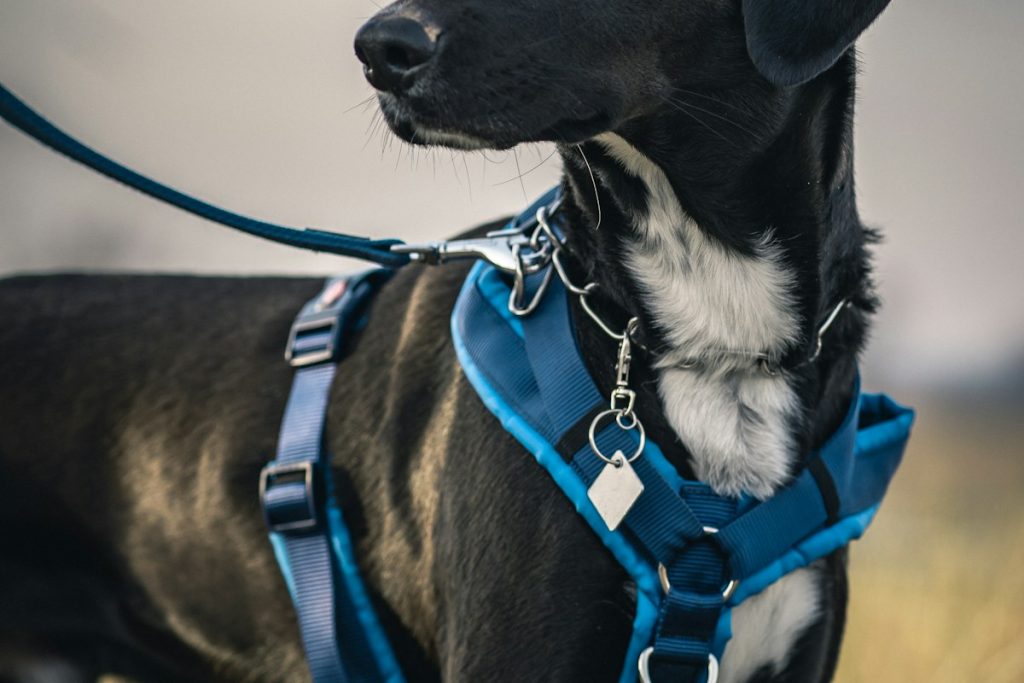
A front-clip harness moves the leash attachment from your dog’s neck to the chest. When your dog pulls toward a trigger, the leash tends to turn them sideways instead of putting pressure on the throat. That gives you a calmer way to steer away from a situation that’s getting too close.
The PetSafe Easy Walk Harness is the one most owners will recognize. Per PetSafe, it has a front chest leash attachment “to steer and guide your dog,” a martingale loop that “puts gradual pressure on your dog’s shoulders,” and it rests across the chest instead of the throat to stop gagging and choking. Quick-snap shoulder and belly straps make it easier to put on a wiggly dog.
Use PetSafe’s measuring guide before you order. And remember: a harness reduces pulling, but it doesn’t change how your dog feels about the trigger.
2. A long line for low-pressure walks
A long line lets you take your dog to a quiet field or empty park and give them room to sniff and explore, while keeping plenty of distance from anything that worries them.
We like a 30-foot line for this. It’s long enough to feel like freedom and short enough to manage. Always clip it to a harness, never a flat collar, and practice handling the extra length somewhere empty before you need it. Our long line buying guide covers lengths, materials and safe handling in more detail.

3. A treat pouch and high-value treats
Counter-conditioning only works if the good stuff shows up the moment your dog sees the trigger. A dedicated treat pouch puts food in your hand fast.
The PetSafe Treat Pouch Sport is a solid, simple option. PetSafe lists a hinge closure, a divided inner pocket to separate treats, a belt clip plus a detachable, adjustable belt, a front pocket for poop bags or a phone, and it’s machine washable on a cold cycle.
What goes in the pouch matters just as much. Reactive-dog work happens around stressful things, so dry biscuits rarely compete. Small, soft, smelly treats work better, and you’ll use a lot of them, so keep an eye on calories. The American Kennel Club’s guideline is that treats should make up no more than 10% of your dog’s daily calories. Our guide to low-calorie training treats has picks that work for adult dogs too.
4. A basket muzzle, conditioned slowly, for safety
A muzzle isn’t a punishment or a training tool. It’s a safety layer for situations you can’t fully control, like vet visits or crowded spaces.
The type matters. Cornell University’s Riney Canine Health Center notes that a properly fitted basket muzzle allows a dog to pant, drink water and accept treats, while nylon muzzles that constrict the mouth “are not appropriate for most situations.” That’s important for reactive-dog training, because you need to keep feeding through the muzzle.
The Baskerville Ultra Muzzle from The Company of Animals is the basket muzzle you’ll see most often. The maker describes it as made from durable thermoplastic rubber and designed to let your dog pant, drink and take treats while it’s on. It comes in multiple sizes, and the maker says to go by nose length if nose length and circumference point to different sizes.
How to muzzle-condition your dog
Cornell’s basket muzzle training guide lays out a gradual, treat-based approach. The short version:
- Put a high-value treat inside the muzzle and let your dog approach at their own pace. Don’t push it toward them.
- When their nose goes in for the treat, praise and slowly pull the muzzle away.
- Present the empty muzzle. When your dog puts their nose in, feed a treat through it right away.
- Keep sessions short, about 5 to 10 minutes, and practice several times a week.
- Once your dog happily pushes their nose in, loosely fasten the strap and reward immediately. A properly adjusted strap leaves room for one to two fingers underneath.
Cornell also advises never leaving a muzzled dog unattended, since they could chew it or swallow pieces.
5. A food toy for decompression at home
After a hard walk, many reactive dogs come home wound up. Giving them a calm, absorbing job, like working food out of a toy, is an easy way to help the day end on a quieter note. We’ll be upfront: there’s little research on food toys and reactivity specifically. We treat them as enrichment and as a pleasant routine, not as a treatment.
The KONG Classic is the standby. KONG describes it as 100% natural rubber and a “mentally stimulating toy,” and suggests stuffing it with kibble and a dash of peanut butter. It’s sized by your dog’s weight, it’s meant for supervised use, and KONG says to stop using it if it’s damaged.

Lick mats are another option. The AKC recommends using them with supervision, choosing food-grade mats, and checking that any peanut butter you use is free of xylitol, a sweetener that’s toxic to dogs.
What about calming supplements and pheromone diffusers?
Calming chews and plug-in diffusers are some of the most heavily marketed products for anxious dogs, so here’s where the evidence actually stands.
- Dog-appeasing pheromone (DAP) diffusers and collars. A 2010 systematic review in the Journal of the American Veterinary Medical Association (Frank, Beauchamp and Palestrini) found that only one dog study provided sufficient evidence that DAP reduces fear or anxiety, and that was during training. Six other dog studies were insufficient. A 2021 review in Veterinary Evidence (Wong and Govendir) concluded that the evidence for DAP in dogs over six months of age “remains weak,” though it’s unlikely to cause harm.
- Supplements and calming diets. The Merck Veterinary Manual lists l-theanine, melatonin and a diet containing alpha-casozepine and l-tryptophan among products that “have been found to have potential therapeutic effects” in reported studies. It also notes that very few behavioral drugs have been tested in rigorous randomized controlled trials.
Our take: the evidence is limited and mixed, so we’re not recommending a specific product here. If you want to try one, check with your vet first. They know your dog’s health history and current medications, and they can tell you whether prescription anti-anxiety medication is worth discussing instead. Wong and Govendir also make a useful point for owners on a budget: don’t put pheromone products ahead of approaches with established effects.
Which tools should you avoid, and why?
Prong collars, choke chains and shock (electronic) collars all work by causing discomfort or pain. AVSAB’s 2021 position statement names all three as tools to avoid and links aversive training to “increased anxiety and fear-related aggression, avoidance, and learned helplessness.” The Merck Veterinary Manual agrees that positive punishment-based training is more likely to lead to fear, avoidance and increased aggression.
For a reactive dog, the problem is easy to see. If spotting another dog comes with a jab or a shock, other dogs start predicting pain, the opposite of what counter-conditioning teaches.
We’d also leave the retractable leash at home. For reactive-dog walks you want a fixed, predictable length you can shorten quickly, plus a long line when you’re somewhere open and quiet.
How do you layer these tools in a real training plan?
No dog needs all five tools on every outing. Match the tool to the situation:
| Situation | Tools to use | Why |
|---|---|---|
| Everyday neighborhood walk | Front-clip harness, fixed leash, treat pouch | Steer away from triggers and pay the moment your dog notices one |
| Planned training session at a safe distance | Treat pouch with high-value treats, harness | Counter-conditioning needs fast, frequent, valuable rewards |
| Quiet field or empty park | Long line clipped to the harness | Sniffing and exploring with plenty of space from triggers |
| Vet visits or unavoidable close quarters | Conditioned basket muzzle | A safety layer, only after your dog is comfortable wearing it |
| Back home after a tough walk | Stuffed KONG or lick mat | A calm, supervised job that helps the day wind down |
For the training protocol these tools plug into, including threshold distance and pattern games, see our guide to leash reactivity. If you’re still working out whether your dog is reactive at all, start with what dog reactivity is.
Free Download
Get the Reactive Dog Toolkit
Includes a Trigger Journal, a de-escalation cheat sheet, a threshold worksheet and an equipment checklist. Free.
When to get professional help
Tools and home training help many reactive dogs, but some situations call for an expert. Bring in a qualified, reward-based behavior professional, or ask your vet about a referral to a veterinary behaviorist, if:
- Your dog has bitten or tried to bite a person or another dog.
- Anyone in your household feels unsafe walking your dog.
- Reactions are getting stronger or more frequent, or progress has stalled. VCA’s behaviorists advise taking a break from training until you can consult a behavior professional in that case.
- The reactivity appeared suddenly or comes with other changes. A vet check can rule out pain or illness.
A veterinary behaviorist can also adjust your training plan and, where appropriate, prescribe medication, which is a very different conversation from an over-the-counter supplement.
Frequently asked questions
What is the best calming tool for a reactive dog?
There isn’t one tool that calms reactivity. For most owners, the most useful starting kit is a front-clip harness, a treat pouch with high-value treats and plenty of distance from triggers. Those support counter-conditioning, which is the training that actually changes how your dog feels.
Do calming supplements work for reactive dogs?
The evidence is limited. The Merck Veterinary Manual lists l-theanine, melatonin and certain calming diets as having potential effects in reported studies, but rigorous trials are scarce. Check with your vet before trying any supplement, and ask whether prescription medication is worth discussing.
Do pheromone diffusers help reactive dogs?
Probably not much on their own. A 2010 systematic review in JAVMA found sufficient evidence for dog-appeasing pheromone in only one dog study, and a 2021 review in Veterinary Evidence rated the evidence for adult dogs as weak. They’re unlikely to cause harm, but they shouldn’t replace training.
Is it cruel to muzzle a reactive dog?
No, not when it’s a well-fitted basket muzzle your dog has been taught to like. Cornell’s Riney Canine Health Center notes that a basket muzzle lets a dog pant, drink and take treats. Introduce it slowly with treats, and never leave a muzzled dog unattended.
Should I use a prong or shock collar on a reactive dog?
No. AVSAB’s 2021 position statement recommends reward-based methods only and names prong collars, choke chains and shock collars as tools to avoid. Pain during trigger sightings can make other dogs or people predict discomfort, which works against the training you’re trying to do.
More in our reactivity series
- Reactive vs aggressive dog: how to tell the difference
- Counter-conditioning and desensitization, step by step
- When to hire a dog behaviorist
- The full dog reactivity guide
Bottom line
The best calming tools for reactive dogs are the boring, humane ones: a harness that steers, a long line for space, a pouch full of great treats, a muzzle your dog actually likes, and a food toy for winding down. Skip anything that works through pain, and treat supplements and pheromones as a “talk to your vet” question rather than a fix. The tools make the work easier. The training is what changes your dog.
More from our Dog Training pillar.
Sources
- AVSAB: Position Statement on Humane Dog Training (2021)
- VCA Animal Hospitals: Introduction to Desensitization and Counterconditioning
- Merck Veterinary Manual: Treatment of Behavioral Problems
- Frank D, Beauchamp G, Palestrini C. Systematic review of the use of pheromones for treatment of undesirable behavior in cats and dogs. JAVMA, 2010
- Wong CF, Govendir M. Can dog appeasing pheromone ameliorate stress behaviours associated with anxiety in mature domestic dogs? Veterinary Evidence, 2021
- Cornell Riney Canine Health Center: Basket Muzzle Training
- AKC: How Many Treats Can a Dog Have?
- AKC: Lick Mats for Dogs
- PetSafe: Easy Walk Harness product information
- PetSafe: Treat Pouch Sport
- The Company of Animals: Baskerville Ultra Muzzle
- KONG: KONG Classic