
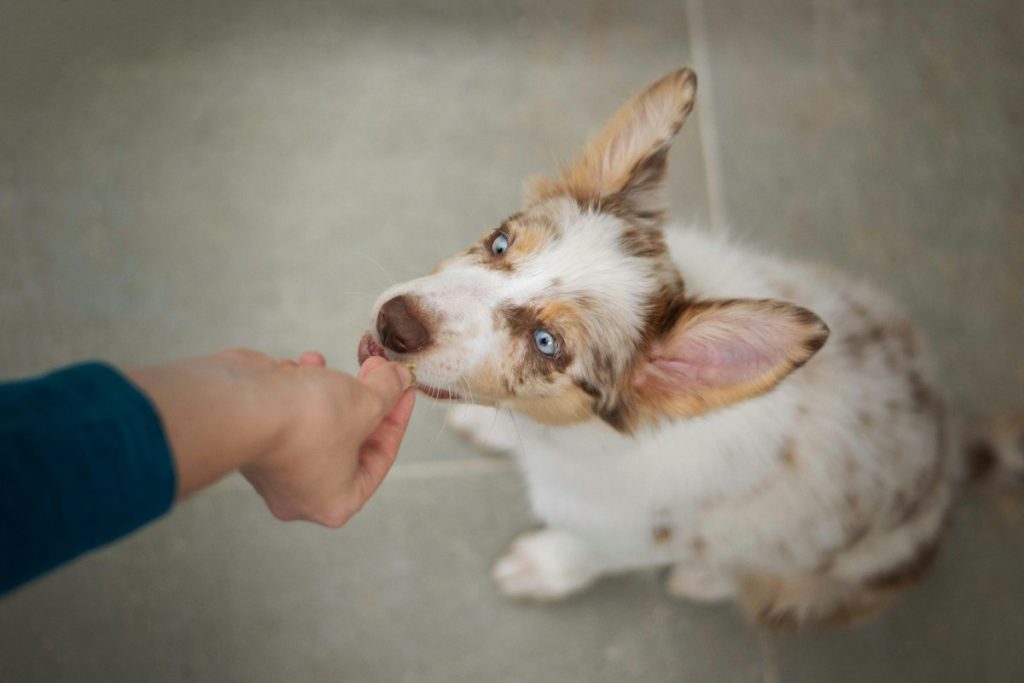
If you’ve read anything about helping a reactive dog, you’ve run into two long words: desensitization and counter-conditioning. They sound clinical, but the idea behind them is simple, and it’s the method veterinary behaviorists reach for first. This plain-English guide, part of our dog reactivity guide, explains what counter-conditioning for dogs actually is, how to run it step by step, and how to tell whether it’s working.
Quick answer: Counter-conditioning changes how your dog feels about a trigger by pairing it with something they love, usually great food. Desensitization keeps the trigger mild enough, through distance or low intensity, that your dog stays calm while that happens. Used together, slowly, they turn “scary thing” into “thing that predicts treats.”
What are desensitization and counter-conditioning?
VCA Animal Hospitals’ veterinary behaviorists define desensitization as gradually and systematically exposing a pet to a trigger “until the stimulus no longer triggers an emotional response.” Counter-conditioning is when the trigger “is paired with something known to create a positive emotional response.” The American Kennel Club puts it more simply: counter-conditioning means “pairing every presentation of the stimulus with something your dog finds fabulous.”
| Desensitization (DS) | Counter-conditioning (CC) | |
|---|---|---|
| What it controls | How intense the trigger is | What the trigger predicts |
| What you do | Start far away, quiet or still, then build up in small steps | Every time the trigger appears, something wonderful follows |
| Example with another dog | A calm dog standing still across a large field | Your dog notices that dog, and chicken starts arriving |
| Goal | Your dog stays calm enough to learn | Your dog’s feeling shifts from worry to anticipation |
You almost always use them together, because a panicking dog won’t eat or learn.
Why does counter-conditioning work?
Your dog’s reaction to a trigger is mostly an emotional one. Barking and lunging are the visible part of a feeling like fear or frustration. Counter-conditioning works on the feeling, not the behavior, by repeatedly teaching your dog that the trigger predicts good things. The Merck Veterinary Manual describes it as “the consistent and repeated pairing” of a stimulus that causes an unpleasant response with something positive.
The order matters. The trigger appears first, then the food comes. When the trigger leaves, the food stops. That way the trigger becomes the signal for treats. If you start feeding before your dog has noticed the trigger, you risk the opposite: food starting to predict that something scary is about to show up.
What is threshold, and how do you find it?
Threshold is the single most important idea in this whole process. It’s the point where your dog stops being able to cope and starts reacting. Below it, your dog can notice the trigger, take food and respond to you. Above it, learning shuts down.
VCA’s guidance is that desensitization “begins with a very low intensity of exposure, low enough that any reaction is minimal.” You lower the intensity by increasing distance, reducing volume or slowing movement. The AKC’s version: find the level “where your dog doesn’t respond negatively.”
Signs your dog is under threshold
- Takes treats gently and readily
- Can look away from the trigger and back to you
- Responds to their name or an easy cue
- Body stays loose, with normal breathing
Signs your dog is getting close to or over threshold
The ASPCA’s canine body language guide lists stress signals including whale eye (lots of white showing), lips pulled back at the corners, yawning and lip licking, a tucked or stiffly wagging tail, raised hair along the back, leaning away, trembling and freezing. Add hard staring, refusing food, barking and lunging.
To find your starting distance, begin farther away than you think you need. The distance where your dog notices the trigger but still eats easily is your working distance. Write it down as your baseline.
A step-by-step counter-conditioning protocol
This protocol follows the gradual approach described by VCA’s behaviorists and the AKC’s sample plan for dogs who are fearful of other dogs. Work on one trigger type at a time.
Step 1: Gather your tools and charge a marker (optional)
For pure counter-conditioning, the food itself does the work. A marker, either a clicker or a short word like “yes,” becomes useful for games like Look at That later on. To charge it, click or say the word and give a treat, many times in a quiet room, until your dog perks up at the sound.
If you want a clicker, the Karen Pryor i-Click is a popular pick. Karen Pryor Clicker Training describes it as a quiet click, “perfect for classes or sound sensitive animals,” with a trigger that needs only a small amount of pressure.
Step 2: Set up a controlled exposure
Where you can, recruit a friend with a calm dog. The AKC’s sample plan starts with your dog about 20 feet from “a quiet and still dog,” but your dog’s distance may be much larger. Use whatever distance keeps your dog under threshold.
Step 3: Trigger appears, treats flow
The moment your dog notices the trigger, start feeding small, high-value treats one after another. When the trigger leaves your dog’s view, the treats stop. Repeat. VCA notes that tasty food treats are commonly used to create a positive emotional state, so this is not the time for plain kibble.
You’ll go through a lot of treats, so pick something tiny. Zuke’s Mini Naturals are about 2 calories per treat, per Zuke’s, and the AKC’s guideline is to keep treats under 10% of your dog’s daily calories. Cut back their meals a little on heavy training days.

Step 4: Shrink the distance in small steps
Only move closer when your dog is clearly happy at the current distance. The AKC’s plan moves one foot at a time and says to decrease distance only “when your dog is anticipating the treat,” meaning they see the trigger and look to you for food.
Step 5: Change one thing at a time
Distance is only one variable. Once your dog is comfortable near a still, quiet dog, the AKC’s plan goes back to the starting distance and adds movement, then later adds noise. VCA suggests breaking triggers into parts in the same way. Every time you make one thing harder, make everything else easier.
Step 6: Keep sessions short and stop on a good note
VCA recommends practicing at least twice a week, daily if you can, with sessions anywhere from 5 to 45 minutes that “should not be stressful.” If your dog shows a mild reaction, move away until they relax, then either end the session or resume at a lower intensity.
Step 7: Generalize to new places
Progress with one dog in one park won’t automatically carry over to a strange dog on your street. Repeat the process with new dogs and new locations, starting each new setup at a bigger distance than you ended with last time.
Look at That: a game that builds on counter-conditioning
Look at That (often shortened to LAT) was developed by behavior consultant Leslie McDevitt as part of her Control Unleashed program, and it’s one of the games she describes in her first book, Control Unleashed: Creating a Focused and Confident Dog. Instead of telling your dog not to look at the trigger, you reward them for looking calmly.
A basic version for a reactive dog:
- Start at your working distance, with a charged marker and a pouch full of treats.
- When your dog looks at the trigger, mark (“yes” or click) the moment they orient toward it.
- Your dog turns back to you for the treat. Deliver it.
- Repeat for a handful of looks, then move away and take a break.
- Once your dog is offering the look-and-turn-back smoothly, you can add a cue, such as “Where’s the dog?”
If your dog can’t look away from the trigger, you’re too close.
How do you track counter-conditioning progress?
Progress is slow and uneven, so keep a simple log, one row per session:
| Column | What to record |
|---|---|
| Date and place | Where you trained, and how busy it was |
| Trigger | What you worked on (for example, a calm dog walking across a field) |
| Closest calm distance | The nearest distance where your dog still took food easily |
| Reaction score | 0 = relaxed, 1 = alert but eating, 2 = stiff or slow to eat, 3 = barking, lunging or refusing food |
| Recovery time | How long it took to settle after any reaction |
| Notes | Anything unusual: weather, a bad night’s sleep, a surprise trigger |
Over weeks, you’re looking for the closest calm distance to shrink, reaction scores to drop and recovery times to shorten. An occasional bad session is normal; a downward trend means slow down or get help. Our free Reactive Dog Toolkit includes a printable Trigger Journal built for exactly this.
Free Download
Get the Reactive Dog Toolkit
Includes a Trigger Journal, a threshold distance worksheet, a de-escalation cheat sheet and an equipment checklist. Free.
What are the most common counter-conditioning mistakes?
- Going too fast. The Merck Veterinary Manual is blunt: “Moving too quickly provokes anxiety and sabotages any behavior modification program.” If in doubt, add distance.
- Flooding. Flooding means exposing a dog to a trigger at full intensity until they stop reacting, like dragging a dog-reactive dog into a dog park. Merck says it is “seldom effective and has welfare implications in dogs,” and the AKC warns that your dog is far more likely to end up even more frightened.
- Feeding before the trigger appears. Keep the order: trigger first, then food.
- Punishing reactions. Corrections add more bad feelings to the trigger. AVSAB’s position statement calls for reward-based methods only, including for behavior problems.
- Uncontrolled exposures between sessions. Every time your dog goes over threshold on a regular walk, it works against your training. Manage walks with distance, quieter routes and quieter times of day while you build progress. Our leash reactivity guide covers day-to-day walk management.
How long does counter-conditioning take?
There’s no honest single answer. Merck notes that desensitization and counter-conditioning “are extremely time-consuming,” and progress depends on how intense your dog’s reactions are, how many triggers they have, how often you can practice and how well you can control exposures. Some dogs improve noticeably in a few weeks. Others need months, plus professional support.
When should you bring in a professional?
Counter-conditioning is something owners can do, but timing and reading body language take practice. VCA’s behaviorists note that it “is always helpful to work with a professional who has had experience managing the timing of rewards.” Get help from a reward-based behavior professional or a veterinary behaviorist if:
- Your dog has bitten or tried to bite a person or another dog.
- Your dog seems to be getting more sensitive instead of less. VCA advises taking a break until you can consult a behavior professional.
- Progress has stalled for weeks despite consistent work.
- You can’t find any distance where your dog stays under threshold.
- The behavior changed suddenly, which is worth a vet visit to rule out pain or illness.
A veterinary behaviorist may adjust your technique or recommend medication, according to VCA. If you’re not sure whether your dog is reactive or something more serious, our guide to what dog reactivity is is a good place to start.
Frequently asked questions
What is counter-conditioning in dog training?
Counter-conditioning changes your dog’s emotional response to a trigger by pairing it with something they love, usually high-value food. Over many repetitions, the trigger starts to predict good things, so your dog feels less worried or frustrated when it appears.
What is the difference between desensitization and counter-conditioning?
Desensitization controls how intense the trigger is, starting far away or very mild and building up slowly. Counter-conditioning controls what the trigger predicts, by following each appearance with something wonderful. They work best together.
What does it mean when a dog is over threshold?
A dog over threshold is too stressed to learn. Common signs include refusing food, hard staring, stiff body, barking or lunging. If your dog goes over threshold, calmly move away until they relax, then work at a greater distance.
How long does counter-conditioning take for a reactive dog?
It varies widely. The Merck Veterinary Manual calls desensitization and counter-conditioning extremely time-consuming. Some dogs improve within weeks, others need months. Track distance, reaction intensity and recovery time so you can see the trend.
Is counter-conditioning just bribing my dog with treats?
No. A bribe is shown before a behavior to get the dog to do something. In counter-conditioning the trigger appears first and the food follows, whatever your dog is doing, so the trigger itself becomes a signal for good things.
More in our reactivity series
- Reactive vs aggressive dog: how to tell the difference
- 5 calming tools for reactive dogs
- When to hire a dog behaviorist
- The full dog reactivity guide
Bottom line
Counter-conditioning and desensitization aren’t tricks. They’re a slow, steady way to change how your dog feels about the things that scare or frustrate them. Stay under threshold, let the trigger predict great food, change one thing at a time and keep a log so you can see the progress you might otherwise miss. When it stalls or feels unsafe, bring in a professional sooner rather than later.
More from our Dog Training pillar.
Sources
- VCA Animal Hospitals: Introduction to Desensitization and Counterconditioning (Lindell, Feyrecilde, Horwitz, Landsberg)
- AKC: Changing Your Dog’s Behavior With Desensitization and Counter-Conditioning
- Merck Veterinary Manual: Treatment of Behavioral Problems
- AVSAB: Position Statement on Humane Dog Training (2021)
- ASPCA: Canine Body Language
- Fenzi Dog Sports Academy podcast: Leslie McDevitt on Look at That
- Dogwise: Control Unleashed (Leslie McDevitt)
- AKC: How Many Treats Can a Dog Have?
- Karen Pryor Clicker Training: i-Click Original Clicker
- Zuke’s: Mini Naturals