
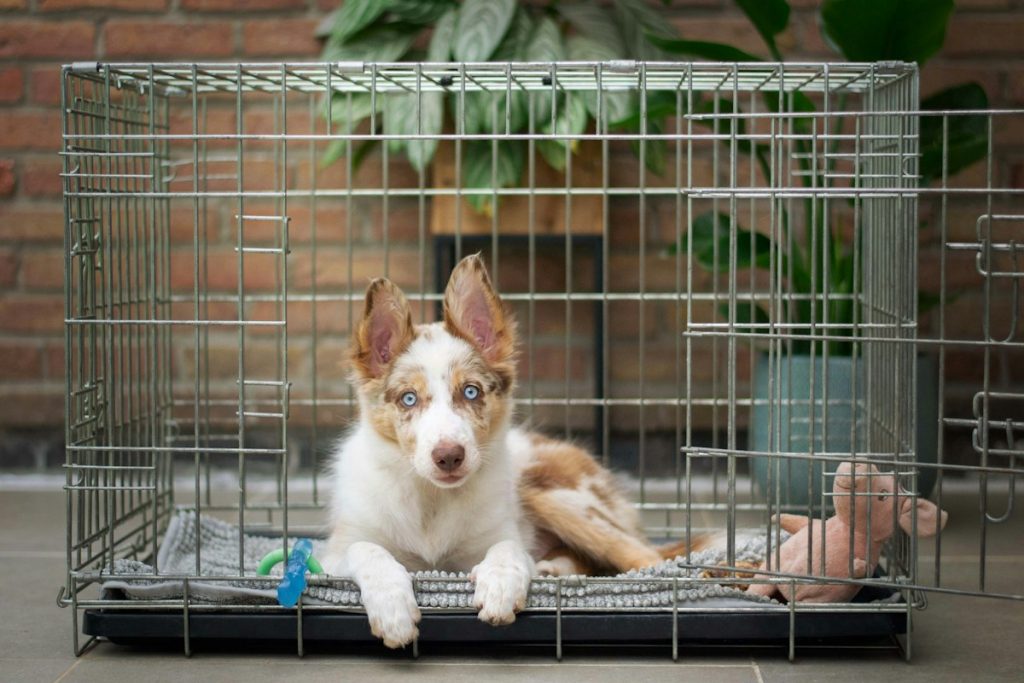
Standing in the pet aisle staring at two very different crates — one a fold-flat wire box, the other a hard plastic shell with a metal door — is a small choice that shapes the next 18 months of your dog’s life. Pick the wrong one and you end up buying a second crate three months later. Pick the right one and crate training gets noticeably easier.
Here is the side-by-side breakdown of wire crate vs plastic crate that we use when we help new owners choose, with a clear recommendation for the situations that actually come up.
Quick answer: Wire crates win for everyday home use — better airflow, easier cleaning, fold-flat storage, and a divider that grows with your puppy. Plastic crates win for car travel, anxious dogs that prefer a den, and airline trips. For most pet owners with one dog at home, a wire crate is the right primary crate.

Hero pick for the wire side: the MidWest iCrate. Two doors, a divider panel that lets a single crate scale from 8-week puppy to adult, fold-flat storage, washable tray. It is the wire crate we recommend by default and what we use with Kai.
The honest difference
Wire and plastic crates are not interchangeable. They solve different problems. Here is what actually separates them when you take both home and use them.
| Factor | Wire crate | Plastic crate |
|---|---|---|
| Best primary use | Home (sleeping, daytime confinement, house training) | Car travel, airline travel, anxious dogs that prefer a den |
| Airflow | Excellent — open mesh on four sides | Limited — small ventilation slots only |
| Visibility for the dog | Full 360-degree view of the room | Restricted, den-like, mostly enclosed |
| Cleaning | Slide-out tray; hose-able when needed | Wipe-down only; harder to fully rinse |
| Storage | Folds flat in seconds | Rigid; takes up shelf or closet space |
| Divider for growing puppies | Yes — sold standard with most models | Rare; usually need to buy the next size up |
| Airline approval | No — wire crates are not IATA-compliant | Yes, if the model meets IATA specs |
| Car safety | Lower — flexes and shifts in a collision | Generally better than wire, but only crash-tested models are proven |
| Chew resistance | Vulnerable at the door joints with dedicated chewers | Vulnerable everywhere with dedicated chewers (plastic is softer than steel) |
| Price range | $40–$120 for a quality home crate | $60–$200, more for airline-spec models |
| Lifespan | 5–10 years with normal use | 5–10 years; longer if not chewed |
Two things to notice. First, airline approval is a hard split — wire crates are not accepted for air cargo by major carriers, while plastic kennels built to IATA Container Requirement 1 are. Second, “den feel” is real for some dogs and irrelevant for others. We will get to that.
When a wire crate wins
Wire is the right choice for the situations that fill most of an owner’s actual week:
- You are crate training a puppy at home. The divider panel is the killer feature. You set it to puppy-size now, slide it back as your dog grows, and one crate covers the entire training journey instead of three. Our overnight crate training guide assumes a wire crate with a divider for exactly this reason.
- Your home is warm. Wire crates breathe. Plastic crates do not. If your dog will spend hours in the crate during summer months in an apartment without strong airflow, wire is safer.
- You want the crate to disappear when not in use. Fold-flat wire models collapse to roughly the thickness of a large pizza box. Plastic crates are always the same size, in use or not.
- You will move the crate room to room. Wire is lighter and the carrying handles fold inward. A medium plastic crate with the rigid shell is awkward to lift through doorways.
- Your dog is social and likes seeing the family. Some dogs settle faster when they can see the people they are bonded to. A wire crate placed in the living area gives them that line of sight; a plastic crate cuts it off.
- Accidents happen during house training. The slide-out tray is far easier to clean than the bonded floor of a plastic crate. House training is messy. Plan for it.
For most first-time puppy owners, the wire crate plus a fitted cover (for when the dog wants the den feel) is the most flexible setup.
When a plastic crate wins
Plastic earns its place in three specific situations:
- Car travel. A rigid plastic shell is more crash-protective than a folding wire box. If your dog rides in the car often — to the park, to daycare, on road trips — a plastic crate strapped to the cargo area or back seat is the safer container. For real crash protection, look for a crate that has passed Center for Pet Safety crash testing — CPS testing has shown that many standard crates of either type aren’t built to survive a collision.
- Airline travel. Wire crates are not accepted for air cargo. If your dog will ever fly, you need an IATA-compliant plastic kennel (think Petmate Sky Kennel, Petmate Vari Kennel, or comparable). Buy this only when you actually need it — they are bulky and not great for everyday home use.
- Your dog is anxious and prefers an enclosed den. Some dogs — particularly noise-sensitive dogs, dogs with separation anxiety, or rescues still settling in — calm down faster in an enclosed space than in an open one. A plastic crate provides that without needing to add a cover.
If two or more of those apply to your dog, plastic is probably the right call as the primary crate.
Choose your situation
If you only have time to read one section, read this one. Match your situation to the recommended crate.
| Your situation | Start with |
|---|---|
| New puppy, mostly at home, normal-size dog at maturity | Wire crate with divider (one crate covers all life stages) |
| New puppy, planning to fly within the first year | Wire crate at home + IATA plastic kennel for the trip |
| Adult rescue with anxiety or noise sensitivity | Plastic crate as primary; add wire later if needed |
| Adult dog, no anxiety, lots of car travel | Plastic crate strapped into the vehicle |
| Apartment with limited storage | Wire crate (folds away when guests visit) |
| Heavy chewer who has destroyed prior crates | Heavy-duty escape-proof wire (e.g., aluminum or reinforced steel) — neither standard wire nor standard plastic will hold |
| Multi-pet household, two dogs both being crated | Two wire crates side by side (easier airflow and visibility) |
| Senior dog with arthritis | Wire on a raised orthopedic pad — easier step-in, better airflow |
The most common pattern we see with new owners: a wire crate as the home crate, and — if travel is in the picture — a separate plastic kennel that lives in the garage until trip day. Two crates for two jobs.
What about safety risks?
Both crate types come with risks worth knowing about.
Wire crate risks. Dogs can catch tags or collars in the bars. Always remove the collar before crating. Cheaper wire crates can develop sharp edges where the welds fail — inspect the door frame and the corners every few months and retire any crate where the wire has bent or splintered. A dog determined to escape can bend a thin-gauge wire crate; if that is your dog, step up to a heavier-gauge model rather than switching to plastic.
Plastic crate risks. Heat is the big one. A closed plastic crate in a parked car can hit dangerous temperatures within minutes — never leave a dog in one in a hot vehicle. Plastic also holds odor; if your dog has an accident in a plastic crate, you need to actually scrub it down rather than just wiping. And determined chewers can bite chunks out of the door frame, which becomes a swallowing hazard.
For either type, the rule is the same: size the crate so the dog can stand up, turn around, and lie down comfortably — no bigger. Oversized crates encourage potty accidents because the dog can soil one end and sleep at the other.
Our recommendation
Buy the wire crate first. For 80% of pet owners, a wire crate with a divider panel — placed in the living area, with a soft pad inside and an optional cover for when the dog wants den feel — covers everything you actually need in year one. It survives the puppy phase, scales to adult size, cleans up after accidents, and folds away when company comes over.
Buy a plastic crate as a second crate when you actually need it: a planned flight, regular car travel, or an anxious dog who clearly settles better in an enclosed space. Do not buy one preemptively “in case” — they are bulky, and an unused plastic crate sitting in the spare room is a sign you spent money on the wrong tool.
If your dog falls into the “anxious rescue who refuses to settle in the wire crate” category, reverse the order: plastic first, wire later if the dog opens up over time.
For a deeper look at picking the right wire crate model — sizing, gauge, divider options, and tier-by-tier picks — see our best wire crates for puppies roundup. And if you are setting up day one with a new puppy, our 5 puppy training essentials covers the rest of the kit alongside the crate.
Frequently asked questions
Is a wire or plastic crate better for crate training a puppy?
A wire crate is usually better for puppy crate training because the divider panel lets one crate cover the entire growth period, and the open design helps the puppy feel connected to the room while still being contained. If your puppy shows clear signs of preferring an enclosed den, add a fitted cover to the wire crate before switching to plastic.
Can I use a plastic crate for nighttime sleep at home?
Yes — many dogs sleep happily in a plastic crate overnight, especially anxious or noise-sensitive dogs. The trade-offs are ventilation (make sure the room is comfortable temperature) and cleaning (accidents are harder to deal with). Wire crates with a cover give you most of the same den effect with better airflow.
Are wire crates safe in the car?
Not for actual crash protection. Wire crates flex and shift in a collision. If your dog rides in the car frequently, a rigid plastic crate strapped down — or a crash-tested travel crate — is the safer container. The Center for Pet Safety publishes crash-test ratings for travel crates if you want to research a specific model.
Do dogs prefer wire or plastic crates?
It depends on the dog. Social, confident dogs often prefer wire because they can see what is going on. Anxious, noise-sensitive, or independent dogs often prefer the enclosed feel of plastic. A reasonable test: try the wire crate with a cover for a week first. If your dog still avoids it, plastic may be worth trying.
Can I fly with my dog in a wire crate?
No. Major airlines (including American, Delta, United, and most international carriers) do not accept wire crates for cargo. You need a rigid plastic kennel that meets IATA Container Requirement 1 — Petmate Sky Kennel and Petmate Vari Kennel are the most common compliant models. Check your specific airline’s requirements before booking.
How big should the crate be?
Big enough for your dog to stand fully upright without ducking, turn around comfortably, and lie down stretched on its side. Not bigger. A too-large crate undermines house training because the dog can use one end as a bathroom and the other as a bed. Wire crates with dividers solve this elegantly — start small, expand as the dog grows.
What if my dog chews through both types?
You need a heavy-duty crate — reinforced steel, aluminum, or escape-proof models like Impact, ProSelect Empire, or Gunner Kennels. Standard wire and standard plastic both lose to a determined chewer. For severe separation anxiety driving the chewing, address the anxiety first with a vet or veterinary behaviorist before throwing more crate money at the problem.
Bottom line
Wire crates are the default home crate for most dogs — better airflow, easier cleaning, divider that grows with a puppy, and they fold away when you do not need them. Plastic crates earn their keep for car travel, airline travel, and dogs that clearly settle better in an enclosed den. Start with wire unless you have a specific reason to start with plastic, and add the second crate only when the use case shows up.
Related reading
- Best wire crates for puppies (2026) — tier-by-tier picks if you have decided on wire
- How to crate train a puppy at night — the actual training protocol
- All dog products guides — pillar with everyth