
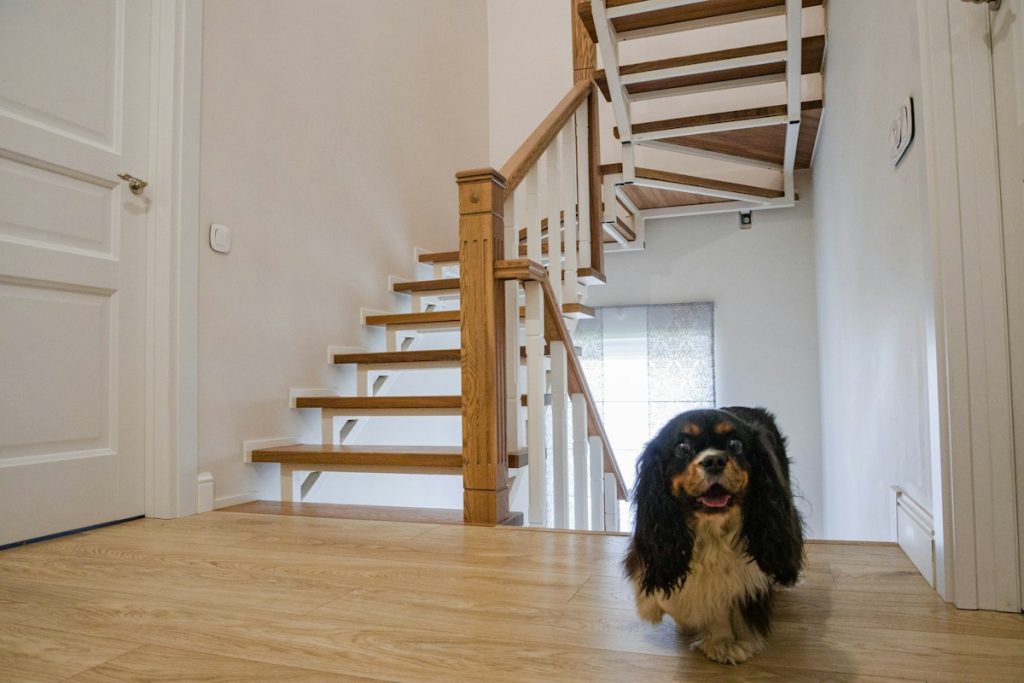
Every jump onto the couch, bed or back seat lands on your dog’s joints. For a young, fit dog that is no big deal. For a senior dog, a dog with arthritis or a long-backed breed, those landings add up fast. A ramp or set of pet stairs takes the jump out of the equation, but the two work differently.
Quick answer: For dogs with arthritis or back problems, a ramp is usually better than stairs because walking up a gentle slope avoids the impact of stepping up. Stairs suit small, agile dogs and take up less floor space. Whichever you pick, look for a non-slip surface, enough width, a sturdy base and a weight rating above your dog’s weight.
Ramp vs. stairs: what’s the difference?
| Dog ramp | Dog stairs | |
|---|---|---|
| Best for | Medium and large dogs, arthritis, back problems | Small, agile dogs |
| Joint impact | Lowest (no stepping up) | Some (each step is a small lift) |
| Floor space | Longer footprint | Compact against furniture |
| Portability | Often folds or telescopes; good for the car | Bulkier, usually stays put |
| Fearful dogs | Often easier to accept | Some dogs need deeper steps |
| Style | Functional | More fabric and color choices |
This lines up with guidance from PetMD, which recommends ramps over stairs for dogs with arthritis or joint and back conditions, and from the AKC, which notes ramps are gentler on sore joints and often lighter for car use.
Which dogs benefit most?
- Senior dogs and dogs with arthritis. Less jumping means less pain. See our guide to the signs of arthritis in dogs.
- Long-backed breeds. The AKC names Dachshunds, Pembroke Welsh Corgis and Basset Hounds as prone to intervertebral disc disease (IVDD).
- Small dogs jumping onto furniture several times their height.
- Large dogs getting into the car, which also saves your back.
- Dogs recovering from surgery or injury, especially on the hips or legs.
- Puppies, whose bones are still developing.
What should you look for?
The AKC’s checklist, in plain terms:
- Traction. A non-slip surface is the most important feature. Slipping once can put a dog off for good.
- Width. Your dog should walk up comfortably without a foot near the edge.
- Incline. The gentler the better for sore joints. Adjustable-angle ramps let you start low.
- Sturdiness and stability. No wobble under your dog’s weight, and a base that sits flat.
- Height. Match the top to your couch, bed or cargo area.
- Weight capacity. Check the stated limit and choose one comfortably above your dog’s weight.
See dog ramps for beds on Amazon →
See folding car ramps on Amazon →
How do you train a dog to use a ramp or stairs?
Most dogs need a few short sessions. Based on the AKC’s advice:
- Let your dog explore it on the floor first. Sniffing is the first step.
- Set it against a wall or barrier so one side is blocked and your dog can’t hop off halfway.
- Start low. With an adjustable ramp, begin at the lowest angle and raise it over days.
- Lure one step at a time with treats or a toy, rewarding each bit of progress.
- Keep it short and positive. Never push, pull or scold a hesitant dog.
- Go easy on older or recovering dogs. A few reps per session is plenty at first.
The same patience-first approach we use in our training guides applies here.
When should you call your vet?
We are dog owners, not veterinarians. If your dog suddenly can’t jump, cries when picked up, drags a back leg or seems wobbly, call your vet right away. In breeds prone to disc disease, sudden back pain or weakness can be an emergency. Your vet can also help you choose between a ramp and stairs for your dog’s specific condition.
Frequently asked questions
Is a ramp or stairs better for a dog with arthritis?
A ramp, in most cases. PetMD recommends a ramp over stairs for dogs with arthritis or back conditions because walking up a slope avoids the impact of stepping up.
Are dog stairs bad for dogs with back problems?
Stairs still ask a dog to step up, which adds some strain. For dogs with back problems, PetMD favors ramps. The AKC notes that breeds prone to disc disease, such as Dachshunds, Corgis and Basset Hounds, benefit from avoiding jumps altogether.
What should I look for in a dog ramp?
A non-slip surface, enough width for your dog to walk comfortably, a sturdy base, a weight rating above your dog’s weight, and a height that matches the couch, bed or car. Adjustable models are more flexible.
How do I train my dog to use a ramp?
Let your dog sniff it, start at a low angle, lure with treats one step at a time, and keep sessions short. Put a wall or barrier along one side so your dog can’t hop off. Never push or pull a hesitant dog.
Do puppies need ramps or stairs?
They can help. The AKC notes that ramps reduce injury risk from repeated jumping while a puppy’s bones are still developing.
What if my dog won’t use either one?
Try a different design, such as stairs with deeper steps or grip pads, or a lower-angle ramp. PetMD notes it may take a couple of products to find the one your dog is comfortable with. A lift harness is another option.
Bottom line
If your dog has arthritis, back trouble or is getting older, a gentle, grippy ramp is usually the better choice. Stairs work well for small, agile dogs and tight spaces. Either one beats a lifetime of hard landings.